Foundations · 3 MIN READ
Build stay one variable at a time
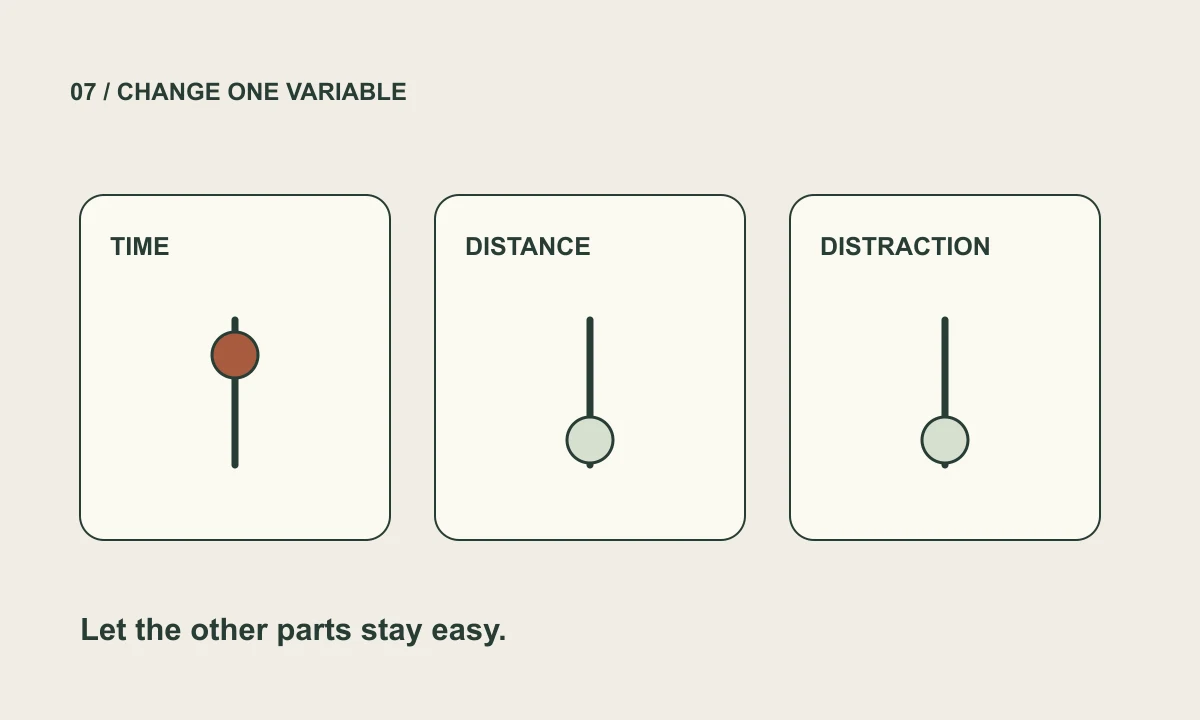
A stay becomes difficult quickly when you ask for more time, walk farther away, and introduce a distraction together. Change one thing at a time. Keep the other parts easier than the dog’s familiar version.
Start with a clear ending
Choose a comfortable position on a nonslip surface. Ask for a brief pause, reward while the dog is still in place, and give a consistent release. A release tells the dog when moving is welcome; without it, the end of the exercise can be hard to understand.
At first, remain close. Reward before your dog is likely to move. If the dog gets up, calmly reset and make the next attempt shorter. There is no need to correct, loom over, or physically replace the dog.
Separate the three questions
Duration asks, “Can you remain here a little longer?” Distance asks, “Can I move away a little?” Distraction asks, “Can you stay while something small changes?” Work on one question while making the other two easy.
For instance, after comfortable two-second pauses close to you, try a tiny step away for one second. Return and reward. A moving toy, an open doorway, or a busy pavement belongs in a later, safer plan. A stay is not a substitute for a leash, closed gate, or other physical protection.
A SMALL EXERCISE
Try it with your dog
- Begin beside your dog and reward a very short, comfortable pause. Use the same release each time.
- Build a little duration while you remain nearby. Mix easy repetitions with small increases.
- On another repetition, reduce duration and move only a small step. Return before rewarding and releasing.
- Try a mild distraction only after the basic version is easy, with time and distance reduced again.
FROM PRACTICE TO A USEFUL RECORD
Record it in DogWhiz
Sign in to use your own dog’s plan. On small screens, look under More for Library, Plan, History, and Household. Check the exercise title before logging; routines can contain several goals.
- Find Stay in Library. Add with prerequisites if its foundation goals are not already in your plan.
- During the Stay exercise, open Session setup and optional measurements. Set Duration seconds and Distance feet to what you actually observed.
- Set Environment and Distraction honestly. In Quick notes, name the single variable you changed and what you held steady.
- In Progress, read duration and distance alongside context. Large recorded values from different attempts do not prove the dog achieved both together.
If it feels difficult
If the dog repeatedly moves, return to a shorter pause or smaller movement. Watch for discomfort, fatigue, and confusion before treating the problem as insufficient practice. Choose an easier position if sitting or lying down appears uncomfortable.
Do not practice beside traffic, an unsecured exit, or a frightening stimulus. A training stage cannot guarantee a dog will remain still.
Sources & further reading
These references support the training principles. Exercises and example logs are original educational suggestions, adjusted to the individual dog. App instructions were checked against the October 21, 2026 review baseline; this article has not received veterinary review.
- Cornell: Training Stay vs. Wait
A clear release, brief initial pauses, and gradual duration and distance.
- AAHA: Canine and Feline Behavior Management Guidelines
Reward-based training, ongoing assessment, medical causes and veterinary collaboration.